Thursday, October 6, 2011
Dancing Rabbit Ecovillage Featured in a COOL New Documentary - Help with a Pledge on Kickstarter!
This summer, during the hottest, brain-meltingest days of July, three filmmakers came to visit. We had no idea what to expect - we get approached all the time by folks who want to film us. Occasionally we say "yes." This time we definately made the right call.
Tamer, Armand and Tom are not only supremely talented but also extremely respectful and thoughtful human beings. They do a lot more listening than they do talking, and while they were here they spent a lot of time getting to know us before ever turning on a camera.
When we saw the trailer they put together we were stunned (in a really good way). These guys get it. They are presenting the three communities of Dancing Rabbit Ecovillage, Red Earth Farms and Sandhill Farm in a clear, thought-provoking, positive way. The film itself is beautiful - the transitions are striking (I love the blueberries in a food processor turning into a cement mixer...) and so many Rabbits and Sandhillers and Red Earth Farms folks are represented.
The clip is below.
As one listens to the first 30 seconds, which was filmed at Sandhill Farm, one is immediately transported to Rutledge, Missouri in the middle of the summer, early in the morning - can you hear the birds and the train in the distance? This is what our life is like here. At 1:12 we see Thomas, working on his hand tools; at 1:23 we see Stan of Sandhill Farm, chopping cabbage with his earthy farmer's hands; at 1:35 we see Alyson, a former Rabbit and current DR Board member, with her daughter Cole; I can be see chatting behind the bar of the Milkweed Mercantile at 1:42; Laird, of Sandhill Farm who is one of the founders of the Fellowship for Intentional Community and a huge supporter of DR and the Mercantile is at 1:46; Ziggy, who is co-creator of Gob Cobitron and author of the A Year of Mud blog is seen tamping the floor in his house at 1:49. At 3:00 you can see Kurt with Rabbit Tom Cowen and our work exchangers Robby and Jordan working on our wind turbine....
Help The Last Volunteer get this film made! As of today it is 54% funded. In eight short days the party is over. Please help!
How's this for an incentive: Contribute $1,000 and you get a night's stay (and dinner!) at the world-famous Milkweed Mercantile. It's a bargain at twice the price!
I realize that most people who read this blog are interested in simple, sustainable living, and therefore may not have a lot of disposable income. I know I certainly do not (although with our latest accounting Kurt thinks we may be making $4.75 a day now!). But this project is so worthwhile - I would love to see the story of Dancing Rabbit and other commuities told by someone who clearly understands and has a gift for story-telling. Even $5 or $10 will help.
Thanks for considering!
Love,
Alline


Wednesday, October 5, 2011
The Kindness of Strangers - Secret Friends Everywhere!
Gifts come from the most astounding, unexpected places, and miracles are everywhere. This morning I opened my email and found this:
"Hello Aline, Kurt and everyone!
By bizarre and convoluted means (arent they always!) I found myself on your site.
I have a small organic garden and was reading up about composting seaweed and came across a post by Aline on the Ventnor Permaculture site.
There was a link to The Milkweed Mercantile and Ive spent a lovely hour looking through your site and various blogs and Im staggered at what you all have accomplished.
I looked backward through Aline's photostream on Flickr and travelled back in time through the building of the Mercantile. First I saw the cheery guests and beautiful rooms and eventually made it through to digging out the basement with your enormous digger!
Initially when I spied beautiful floors, fireplace and the lime plastered walls I assumed you had converted a barn at *considerable* expense. However as I travelled further back through your photos, I discovered to my intense joy you had fulfilled your very own self built 'Grand Design' from scratch!
Oh well done everybody! What a journey! It looks FABULOUS and so warm and inviting. But my goodness what a lot of work- I mean crazy amounts! Kurt and Aline, I have so much respect for your vision and energy. To envision the possibility of 'what could be' from 'what was' is rare gift!
And you had so much help from your community! So many smiles and waves to camera throughout the process Aline and Kurt are truly blessed with friends and neighbours who have gone above and beyond to help create the amazing guesthouse and cafe.
I never knew of you until an hour ago, and probably couldn't find Rutledge, MO with an hour, two hands and a paper map! My life is very different, I have a a busy urban life in London, but Im genuinely proud of your achievements:-
The wonderful cafe kitchen, the PV panels, wind turbines, the strawbale construction, reclaimed doors and floors, Tamar's beautiful mosaic swirls... all created with such good grace and a passion for quality work. Its absolutely shines through in everything you've done.
Congratulations one and all!
Have a good day!"
Wow. I'm considering printing this out and carrying it around in my pocket, as a touchstone of sorts, on those days when all I can see is what hasn't yet been done, when I forget what we've actually accomplished.
This is also a very good reminder of the power of connection, and how a kind word can make a world of difference.
I really am speechless. I'm sitting here at my computer with a big smile on my face. Words are pretty much failing me, so I'll just finish by saying Thank you Anne-Marie. You made my day!
"Hello Aline, Kurt and everyone!
By bizarre and convoluted means (arent they always!) I found myself on your site.
I have a small organic garden and was reading up about composting seaweed and came across a post by Aline on the Ventnor Permaculture site.
There was a link to The Milkweed Mercantile and Ive spent a lovely hour looking through your site and various blogs and Im staggered at what you all have accomplished.
I looked backward through Aline's photostream on Flickr and travelled back in time through the building of the Mercantile. First I saw the cheery guests and beautiful rooms and eventually made it through to digging out the basement with your enormous digger!
Initially when I spied beautiful floors, fireplace and the lime plastered walls I assumed you had converted a barn at *considerable* expense. However as I travelled further back through your photos, I discovered to my intense joy you had fulfilled your very own self built 'Grand Design' from scratch!
Oh well done everybody! What a journey! It looks FABULOUS and so warm and inviting. But my goodness what a lot of work- I mean crazy amounts! Kurt and Aline, I have so much respect for your vision and energy. To envision the possibility of 'what could be' from 'what was' is rare gift!
And you had so much help from your community! So many smiles and waves to camera throughout the process Aline and Kurt are truly blessed with friends and neighbours who have gone above and beyond to help create the amazing guesthouse and cafe.
I never knew of you until an hour ago, and probably couldn't find Rutledge, MO with an hour, two hands and a paper map! My life is very different, I have a a busy urban life in London, but Im genuinely proud of your achievements:-
The wonderful cafe kitchen, the PV panels, wind turbines, the strawbale construction, reclaimed doors and floors, Tamar's beautiful mosaic swirls... all created with such good grace and a passion for quality work. Its absolutely shines through in everything you've done.
Congratulations one and all!
Have a good day!"
Wow. I'm considering printing this out and carrying it around in my pocket, as a touchstone of sorts, on those days when all I can see is what hasn't yet been done, when I forget what we've actually accomplished.
This is also a very good reminder of the power of connection, and how a kind word can make a world of difference.
I really am speechless. I'm sitting here at my computer with a big smile on my face. Words are pretty much failing me, so I'll just finish by saying Thank you Anne-Marie. You made my day!
Thursday, September 15, 2011
Dancing Rabbit Ecovillage Open House - Saturday, September 24th

Annual Open House
Saturday, September 24, 2011
from 1:00- 4:00 p.m.
and we really want you to be here!!!
Come enjoy free tours, a peek inside several of the private homes, an insider's guide to life off the grid, info on renewable energy, building with alternative and sustainable materials, a village fair, live music, and much much more! We hope to see you there!

Our children are slow but cute. Please don't run over them.
If you get lost we'll be in the Milkweed Mercantile most of the day and can help talk you in. Our phone number is 660-883-5522. Please note that AT&T does NOT have cell phone reception in this area (maybe they're not so smart after all...)
Wear comfortable shoes, bring a jacket and maybe an umbrella, and your friends!

The Rabbits demonstrate car-sharing.
A google map is available here: http://tinyurl.com/mmdirections
Our GPS Coordinates are:
40 degrees 19.953' N
92 degrees 5.766' W
40 degrees 19.953' N
92 degrees 5.766' W
Driving directions from just about everywhere:
From the NORTH (Minneapolis, Des Moines):
- Follow 35 South from Minneapolis.
- In Des Moines, take the exit onto I-80 E toward Davenport 3.4 mi
- Take exit 141 to merge onto US-65 S toward Altoona/Des Moines 4.5 mi
- Take exit 79 for IA-163/E University Ave toward Pleasant Hill 0.4 mi
- Turn left at IA-163 E/E University Ave
- Continue to follow IA-163 E
- Continue onto US-63 S
- After going through the town of Bloomfield, turn left on Iowa Route 2.
- Head east to Iowa Route 15 and head south (a right turn onto 15). NOTE: If you are driving by during business hours, Milton Creamery has AMAZING cheese. They are on Route 2 on the right just before you turn onto Highway 15. Absolutely worth the stop. We highly recommend Prairie Breeze and Prairie Rose.
- As you cross the state line it will turn to Missouri Route 15.
- Continue on Route 15 all the way through Memphis.
- Several miles south of town at the bottom of the hill, take a left turn to head east on 136.
- Continue on 136 for a couple of miles. After the Pizza Hut and J’s Grocery store, turn right at Ridge Road/Highway MM.
- Ridge Road//Highway MM.will take you along the ridge, down into the river bottom, over the creek and back up the other side.
- At the T intersection, turn LEFT on Highway M.
- M will twist and turn, and eventually come to another T intersection. M goes left, W goes right. Turn LEFT, continuing on Highway M.
- When you see the sign where you take a right turn to stay on M and go into Rutledge, go straight instead, continuing on Route A. Take your first left turn in about 100 yards. THERE IS NO ROAD SIGN HERE BUT TURN LEFT ANYWAY. If you reach the railroad bridge (or the town of Gorin) you have gone too far.
- Go one mile and take a SHARP left turn on the first gravel road, once labeled "Woehrle" but sadly no longer labeled THERE IS NO ROAD SIGN HERE BUT TURN LEFT ANYWAY (we're working on putting up our own signs, but we haven't gotten to it quite yet!).
- Ignore the gravel road that goes off to the right and continue on 0.8 miles and you'll see the Dancing Rabbit sign on the right.
- Turn in at the next entrance, where visitor parking is located on your left.
From the EAST and SOUTH (Quincy, St. Louis):
- From US 61 near Quincy IL, head west on Missouri 6.
- Go 32 miles to Knox City and take a right on V (there is a route V after just a few miles on Hwy 6 - DONT TAKE IT, it is the WRONG V. ).
- When you come to a tee intersection, take a left on K.
- Go a few miles and take a right (north) on M--you'll see a sign that says "Rutledge 5 miles."
- Cross the line into Scotland County and go through Rutledge on M.
- Just north of the town, M comes to a tee intersection--go right (east) on A.
- Take your first left turn in about 100 yards. This road does not have a sign. If you cross the railroad overpass/bridge you have gone too far.
- Go one mile and take a sharp left turn on the first gravel road, once labeled "Woehrle" but sadly no longer labeled (we're working on putting up our own signs, but we haven't gotten to it quite yet!).
- Ignore the gravel road that goes off to the right and continue on 0.8 miles. You'll see the Dancing Rabbit sign on the right.
- Pull into the second driveway and park in the lot on your left
- The Mercantile is the big white building with the porch.
For an internet map follow this link: http://tinyurl.com/4xlfa7
From the SOUTH and WEST (Kirksville, Columbia, Kansas City):
- Take US 63 north to Kirksville, where it will turn into North Baltimore Street.
- Take a right on Missouri 11 (the Hyvee store is a good landmark).
- After 20 or so miles, you'll come to a stop sign--go straight, crossing over Missouri 15. At this point, 11 will turn into highway K.
- Go through Baring on K, and after a 6.5 miles on K, take a left (now heading north) onto M. You'll see a sign saying "Rutledge 5 miles"
- Follow M all the way through the town of Rutledge until in stops at a tee intersection. Just north of the town, M comes to a tee intersection--go right (east) on A.
- Take your first left turn in about 100 yards. This road does not have a sign. If you cross the railroad overpass/bridge or reach the town of Gorin, you have gone too far.
- Go one mile and take a sharp left turn on the first gravel road, once labeled "Woehrle" but sadly no longer labeled (we're working on putting up our own signs, but we haven't gotten to it quite yet!).
- Ignore the gravel road that goes off to the right and continue on 0.8 miles and you'll see our sign on the right.
- Pull into the second driveway and park in the lot on your left
- The Mercantile is the big white building with the porch.
For an internet map follow this link: http://tinyurl.com/6yf7as
From Chicago
- 80 West towards Iowa (approximately 116 miles)
- MergeI-74 E/IL-110 W/CHICAGO-KANSAS CITY EXPYPEORIA
- MergeUS-34 W/IL-110 W/CHICAGO-KANSAS CITY EXPYEXIT46AMONMOUTH
- MergeUS-34 WBURLINGTON (Crossing into IOWA)
- TakeUS-61/ROOSEVELT AVEEXIT261FT MADISON
- TurnRIGHTUS-61/AVENUE L/IA-2US-61/IA-2
- TurnLEFTUS-218 S/IA-27 S
- MergeAVENUE OF THE SAINTS (Crossing into MISSOURI)
- TakeUS-136WAYLAND/KAHOKATurnRIGHTUS-136
- After going 26 miles, turnLEFTMO-A
- When you have covered approximately 8-7 miles you will cross a small overpass bridge that goes over the railroad tracks. Immediately after this is a paved road on your right. This is Old Highway Y. There is not a road sign here. Turn right. (If you get to MO-M you’ve gone about .2 miles too far).
- Go one mile and take a sharp left turn on the first gravel road, once labeled "Woehrle" but sadly no longer labeled (we're working on putting up our own signs, but we haven't gotten to it quite yet!).
- Ignore the gravel road that goes off to the right and continue on 0.8 miles and you'll see our sign on the right.
- Pull into the second driveway and park in the lot on your left
Saturday, August 27, 2011
Timberframe Bent-Raising at Wabi Sabi
NOTE: all photos are clickable for a larger view.
Two of the many things I love about Dancing Rabbit Ecovillage are these:
Two of the many things I love about Dancing Rabbit Ecovillage are these:
1. When you need help, folks come a'runnin'
2. A variety of building methods, techniques, and philosophies are embraced, encouraged and supported.
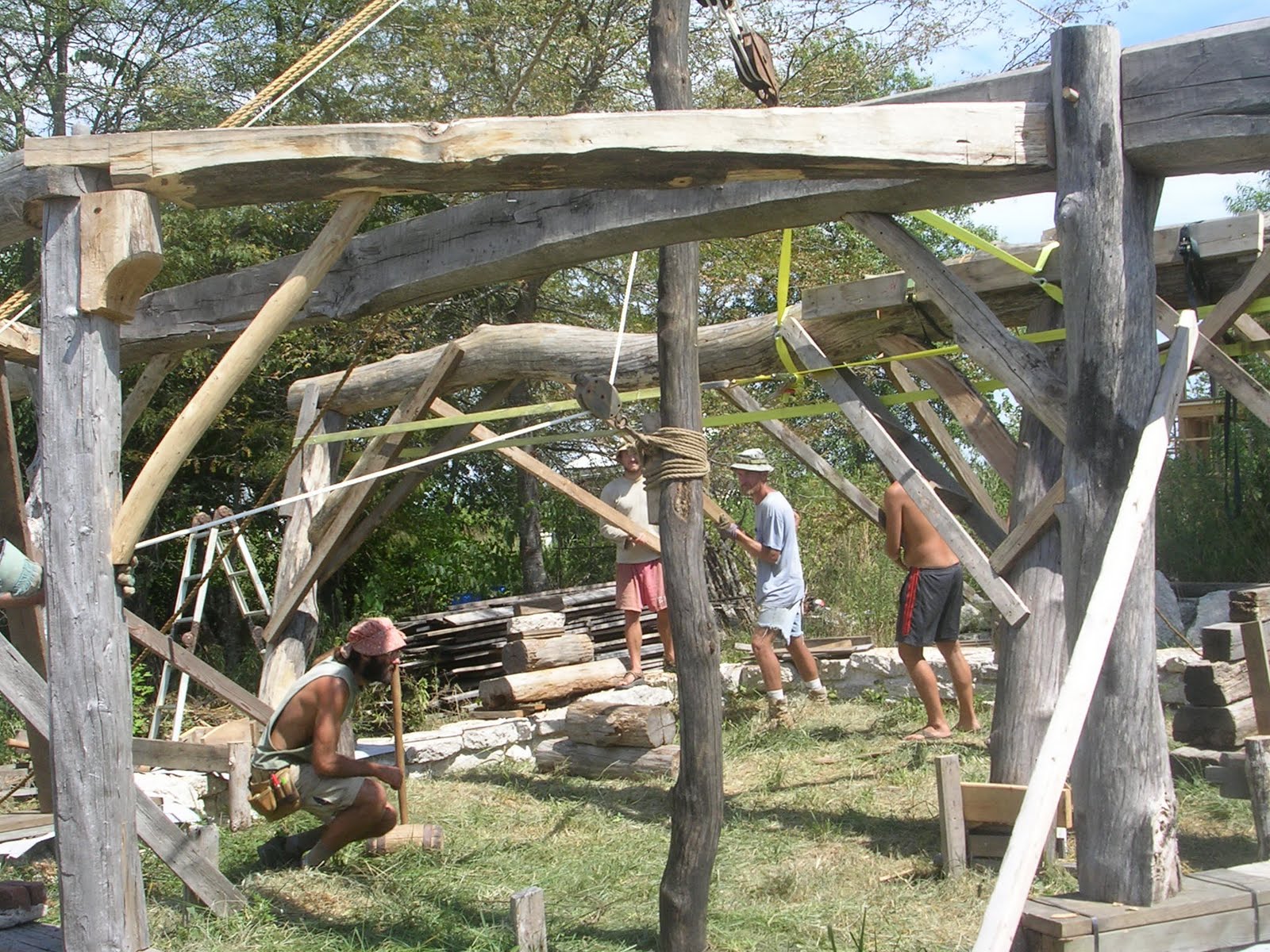
Yesterday was a good example. Wabi Sabi, a food cooperative with Thomas, Ziggy, April and Ali as members, hosted a bent-raising for their under-construction kitchen. Joined by work exchangers Jacob and Jonathan, they've been working hard getting ready for the big moment.
It was an impressive set up. I apologize in advance for the poor photos - I did the best that I could with my goofy outdated camera (hint to Kurt: I need a new one!) while trying not to be crushed to death under beams that surely weighed a zillion pounds. Additionally, April was shooting video that will soon (I suspect) be posted on Ziggy's blog, at A Year Of Mud.
The building is being built with the timberframe method: the method of creating structures using heavy timbers jointed by pegged mortise and tenon joints. So here was the challenge - to get this peg into this hole (one of these on the north and south sides of the building),

and this little piece of rebar into that little hole, on the middle post.

Which doesn't sound like such a big problem until you realize that these pegs/rebar are supporting these mondo huge beams. Here is a view from the other side.

In the photo above you can see how they have rigged up a pulley. Attached to this crossbeam are the three posts which are being lifted into place. We hope.

Here (above) the crew of volunteers gets instructions from Thomas. He's the one on the right in the dashing bonnet. In the background you can catch a glimpse of Wabi Sabi's temporary kitchen, complete with "clerestory" windows.
 |
| Katie, Jordan, Claire, Jacob, Maikwe, Jenny, Marqis, Kate |

About this time Thomas yelled "PULL!" and so they did. At the same time the other half of the crew, below, supported the beam with notched 2x4s.
 |
| Snack, Tim (boots only are visible!), Craig, Dan, Travis, Ziggy |
This is when Ziggy called to the rope pullers "oh! Watch out for the sweet potatoes." OK, Zig. No problem. You can see that Jacob and Jonathan ran around the garden patch to pull while not stomping on dinner. Good job!


Meanwhile, Pug supervised. He did an exemplary job.

While the crew with the 2x4s supports the beam (the rope has been tied off at this point) Ziggy and Thomas check to see how close (or how far) the pegs are from the holes.

The pegs are close! First they adjust the one on the right (south), then move to the middle. This takes a lot of crowbar action and careful support from the 2x4s. Jacob get ready to grab the "persuader." Talk about perfect names for things. The Persuader must weigh at least 20 lbs, and is bigger than Rhode Island.

I realize that this looks like a photo of Ziggy's lovely behind, but it is REALLY a shot of all of the careful aligning being done. Jacob is persuading, Thomas is working the crowbar, BETsey and Marqis are supporting with a 2x4 (as are Snack, Tim, Kurt, DAn...). An impressive group effort!

The pegs pop into place. Kurt and Thomas screw in supports.
And we're done! Which is when the playing begins. Below, Kate demonstrates the power of persuasion on Tim.

Thanks for reading. More soon!
Love,
Alline
Thursday, August 25, 2011
When It's Too Hot to Cook, Cook This.
 GMO soybeans, feed corn, and sunflowers do not make a great meal...
Photo by Julie Traichel.
Living here in the middle of rural Northeast Missouri we don’t have access to the abundance of farmer’s markets like those of you who live in real live cities (my oh my, if you ever have the chance to visit the market at the Ferry Building in San Francisco, do it – check out the photos here). If we were to eat truly local we'd be chewing on GMO soybeans and feed corn. But I digress...
The good news is that we do have a lot of great produce being grown here in the "Tri-communities" of Dancing Rabbit, Red Earth Farms and Sandhill Farm. We've gotten beets, carrots and potatoes from Sandhill, tomatoes from Nani here at DR and Jacob at Red Earth, gorgeous cucumbers and beets from Dan D., who also makes feta and mozzarella cheese. Garlic is available from the Ironweed Garden, we've scrounged hot peppers from Tom & Tereza, and are growing tons of our own basil and other herbs. Each year there are more gardens and gardeners producing more and more great vegetables. It is very exciting.
A few weeks ago we had a streak of record-setting almost-too-hot-to-live days (soaring into the high 90’s, with humidity to match). That kind of weather doesn’t exactly make one want to rush into the kitchen and turn on the oven. So I looked at the gorgeous produce we had waiting for us in our kitchen and went searching for recipies that didn’t involve a lot of cooking. Some ideas came from Mark Bittman, some ideas came from Lorna Sass, some I made up in my own little head.
 Kurt and Alline dining at the Mercantile.
 Here’s what we ate a lot of during the heat wave:
Beets
Roast beets whole (or boil them or buy them precooked), then slice or cube. Toss with a little chopped garlic (or a lot of roasted garlic), toasted walnuts, orange juice and olive oil.
Potatoes
Fast, grown-up potato salad: Boil bite-size red potatoes. While still warm, dress them with olive oil, lemon juice, whole grain mustard, capers and parsley.
Or
boil bite-size potatoes (or new potatoes cut into bite-size pieces). In a separate skillet, sautee a couple cloves of garlic, chopped until it is fragrant. Toss potatoes with garlic and oil, a little salt and freshly ground pepper.
Creamier Hummus
Instead of using garbonzo beans, cook some navy beans (or get a couple of cans of navy beans). Rinse and drain. Put the beans with garlic, lemon juice, olive oil and a pinch of salt in a food processor. Pulse until smooth. If needed, add a bit more oil or lemon juice. Serve with pita bread or pita chips and raw veggies, with a handful of kalamata olives on the side. Speak with an unidentifiable accent and pretend you are somewhere exotic.
Tomatoes
Nothing says summer like a plate of sliced tomatoes. Branch out from those plain old red ones – try the green, the yellow, the purple. You’ll be so glad you did!
Arrange sliced ripe tomatoes on a platter. Sprinkle with crumbled feta cheese. You can add some cukes and some fresh basil if you have some in your garden (I hope you do). Instead of feta, fresh mozzarella is great, too. Drizzle with a balsamic reduction*. You are going to be so darned impressed with yourself.
Carrots
Grate about a pound of (peeled, organic) carrots. In a blender mix approximately 3 Tb. Sweet Mango Chutney, 3 Tb. lime juice, 2 Tb. peanut butter, 2-3 Tb. water, 1 teaspoon salt. In a large bowl toss the grated carrots with the dressing. Top with chopped cilantro and chopped roasted, salted peanuts. Recipe from The New Vegan Cookbook by Lorna Sass. **
Noodles
Cold not-sesame noodles: Cook and cool noodles - udon, soba or even good old fettucine. In a blender or food processor combine about a half-cup peanut butter with a tablespoon soy sauce and enough coconut milk to make the mixture creamy (about a half cup), along with garlic and chili flakes. Toss sauce with cooked and cooled noodles, a load of mint, Thai basil, and/or cilantro, and lime juice. Sprinkle with chopped peanuts. Shredded cucumber and carrots optional.
Happy eating.
* How to make a balsamic reduction:
- Pour the balsamic vinegar into the pan. Use enough so that you allow for it to reduce by half--I like to reduce a whole liter of vinegar and keep it on hand.
- Heat the pan to high.
- Whisk briskly, even prior to boiling. Once it starts boiling, keep whisking constantly to prevent burning.
- Sprinkle in a tablespoon of sugar.
- Reduce by half, or until the vinegar takes on a syrupy quality.
- Allow to cool. You are gonna love this stuff.
Friday, August 19, 2011
The Wind Turbine Goes Up! And Then, Comes Down...
 This is the tower arriving way back in February 2010. It was very cold that day.


 Here's Kurt unloading the tower. He has a good time no matter what he's doing. I like that in a guy.
On July 13, 2011, after a two years of planning (we tend to multi-task so stuff takes a while - see photos, above), we finally raised our wind turbine. It was an amazing, exciting, eagerly awaited event – those in the community who weren’t helping were watching, which was easy to do, as it went on for several days.
We purchased a 100’ tower, which in its previous life was a radio tower at the local hospital. While the tower came with a gin pole (essentially a lever designed to help raise the tower) we still had to figure out how to get the whole thing to work.
Everything at DR is essentially an experiment – when it came time to raise the tower the crew found that there wasn’t quite enough cable to raise it. So with the gin pole alllllllllmmmmmost there, a series of cable extensions were added. It was quite a show.
Below are a few picture with details. I realize that is it not a very comprehensive explanation of how to raise a tower, but it's the best I've got.
 The 100' tower rests on the ground. The gin pole is that thing sticking straight up in the air. Welded to the tower at a 45-degree angle, it is used as a lever to raise the tower. At the far end, in the DR driveway, the turbine is being installed.
 Robby and Tom work on attaching the blades of the 3,000 watt turbine. Tamer and Armand, visiting while making a documentary on communities, film it all.
 This sucker is BIG. At least for us. And no matter what they say, size DOES matter.
 Lots of folks took turns ratcheting the tower up. No wimpy fuel-powered winches for us, no sir-eee! Here Robby demonstrates his manliness.
Slowly the tower went up and up and up. It was very cool to watch. And then, it stopped.
We had run out of cable.
By now the gin pole was really high, and pretty much out of reach. The Mercantile Tower Brain Trust went to work. How to get someone up high enough to attach more cable? Hmmmm. What if we brought out the tractor and put Tom on the bucket? FANTASTIC idea!
 Thomas and Kurt providing ballast while Tom climbs.
 Tom, defying death at every turn, perches (happily) on the tractor bucket to add yet another length of cable. The gin pole is to his upper right, and soooooooo close to the ground.
I secretly think that they (Tom, Thomas, Kurt, et. al) LIKE the drama of projects like this - finding ways to make seemingly impossible situations work out just dandy. They were psyched, and having a good time.
 The crowd looks on anxiously. L-R Kristen, Claire, Haley, Meghan, Armand.
They scrounged up more cable and attached it. We continued to ratchet up the tower. And we ran out of cable. Again.
So they attached more.
 Dave and Thomas connecting the cable extension.
 After fiddling around a bit, the tower was up, the blades were turning in the breeze and power was being collected. It felt like a freaking miracle.
It was an incredible high to look up and see those blades turning, generating power (remember, we don't have TV and so tend to be quite easily amused). We designed the Mercantile's power system to run on both solar and wind - in tandem they are a great duo. Where we are located in Northeastern Missouri it is almost always windy when it isn't sunny. Because the system is fairly large (we have 28 batteries to fill) the power grew incrementally - at first we weren't even sure that the system was working. But it was, and slowly the batteries filled up.
And then came a big storm. On July 28th, the wind blew over the top portion of the wind turbine. Normally we would have been devastated, or at least tremendously bummed. But that morning when we woke up we realized that Baloo was dying, and the wind turbine seemed a lot less important. It was a good lesson in priorities. And also a lesson in the need to make sure the tower one uses is strong enough to hold the turbine placed on top.
 Don't let this happen to you.
So now, a few weeks later we're making the time to work on the turbine yet again. We ordered more blades (to the tune of $2,090 - eek!) and they're waiting to be installed. I'm not quite sure how the crew plans on taking down and putting up the whole thing again. But they'll think of something, and it will definitely be entertaining. I'll keep you updated!
Thursday, August 4, 2011
Bridges to Sustainability
 Saturday Lunch at the Mercantile
Hi all. The following is a column written by our work exchanger Robby Boyer for the local weekly, The Memphis Democrat. That's Memphis, Missouri.
In the summer of 2010, I arrived at Dancing Rabbit Ecovillage to help for six weeks on a natural building project. In the course of these weeks I grew fascinated with a community brave enough to experiment with the comforts of modernity that most Americans take for granted. This short six-week stay was just long enough to inspire to me completely change the focus of my doctoral dissertation research in Urban Planning at the University of Illinois. I have since reoriented my professional and academic life toward investigating Dancing Rabbit and other similar ecovillages, as well as promoting its mission of community-based sustainability.
 Robby playing guitar on the porch of the Mercantile.
In departmental seminars, college lectures, high school assemblies, meetings with municipal urban planners, and even dinner conversations with my friends and family I’ve attempted to explain how residents of Dancing Rabbit have built a fifty-plus member community that generates its own electricity from the sun, cultivates the vast majority of its water from the sky, builds its homes using only recycled and/or locally harvested lumber, recycles all of its organic waste, and survives in rural Missouri with only three shared vehicles.
I returned this summer as both a researcher and an employee at the Milkweed Mercantile Eco Bed & Breakfast—a fascinating business that I will discuss further below. I’m finding that even as a life-long environmentalist and advocate for social change, that daily life at Dancing Rabbit is a challenge. While I am each day more and more encouraged by the successful (and sometimes unsuccessful) experiments in which the “Rabbits” have engaged, I have also encountered the challenges of routine change that come with new, more sustainable ways of living. For example, the amount of electricity I feel comfortable using is heavily dependent upon yesterday’s, today’s and tomorrow’s weather. Even as I type this article, I am reminded of the ‘low’ level of energy available in the community’s common house that has resulted from a rather old and inefficient refrigerator (soon to be replaced!). I’d very much like to wash my clothing at some point this week, but I am finding that this season’s energy shortage may force me to wash my clothing by hand—a relatively time consuming and unfamiliar task to a middle class suburban man.
 Everyone's birthday gets celebrated at the Mercantile. This was Grant's day...
 My excitement about Dancing Rabbit is, in part, the result of my concern for the long environmental and economic emergency of global climate change. All available information I can access paints a rather pessimist picture in the coming decades. But here’s some good news: I am convinced that the vast majority of the physical technology needed to overcome the humanity’s environmental challenges already exists. Humanity has already invented all of the “stuff”—the solar panels, wind turbines, solar ovens, composting toilets, etc.—that we need to live comfortably and at lower impacts on the earth. The real challenge now is how we use this stuff and how we live together, and this will require some routine change. Routine change is hard.
Overcoming the environmental challenges of the twenty-first century will require lots of it, but I’d personally prefer experimenting with small routine changes now than be forced to make terribly uncomfortable routine changes when, for example, gasoline prices approach $10/gallon, or a new climactic reality overwhelms even our “emergency” resources.
For ideologically motivated folks like the residents of Dancing Rabbit, routine change is the new reality. For the vast majority of humans, however, routine change is a taxing endeavor. I have trouble imagining most of my friends and family living at Dancing Rabbit for even longer than one week, let alone a lifetime. This summer, however, I have been encouraged by my experience at the Milkweed Mercantile Eco Bed & Breakfast (The “Mercantile”) and its role as a “bridge” between the radical routine change in the Dancing Rabbit community and guests exploring new ways to live more “sustainably”. It is only appropriate that such a transitional space would manifest in a B&B. The facility exposes guests to energy, water, food, transportation, heating/cooling, and feeding systems of noticeably different, yet comfortably similar dynamics. A guest at the Mercantile, for example, will find many of the same comforts they would find in any other B&B: clean white sheets, large comfortable beds, impeccably clean bathrooms, a delicious and hearty breakfast, a hot shower, running water, a pleasant selection of cold beer, wireless internet, and yes, light switches connected to functioning lights.
 The solar & wind powered Milkweed Mercantile (the porch is still under construction!). That yellow thing in front (in the DR courtyard0 is not a tanning booth, but a community-sized solar oven.
More observant guests, however, will realize that all the electricity is generated by solar panels on-site, all the water is harvested from rain and purified on-site, the air is “conditioned” by straw bale insulated walls, the water is heated in a wood-fire furnace, the food is mostly grown locally, and everything that falls in the toilet is recycled—after a long and careful composting process. Managing such a business and keeping it affordable (under $100/night) for guests is far from conventional. Each morning, for example, my responsibilities include closing the windows of the B&B, a seemingly counter-intuitive routine given the summer’s extreme heat and that the building has no air conditioning unit. But closing the windows effectively traps the cool evening air inside the highly insulated walls so that the air in the inn remains cool relative to the heat outside. Staff at the Mercantile must also monitor rainfall, rotate the compost container, make cooking decisions based on the weather, collect burning material for the water boiler, and make sure to do the inn’s laundry in time for it to dry in the afternoon sun.
 Alline and Kurt (aka "The Milkweeds") owners & proprietors of the Milkweed Mercantile.
The owners of the Mercantile (hey! that's us!) comment that a more sustainable living situation does not require deprivation. Indeed, my experience living and working at Dancing Rabbit has exposed me to an abundant, rewarding, and fun lifestyle that simultaneously offers me the chance to be a better global citizen. While I do not expect the world to dive into radically new living practices overnight, I do think that radical change is necessary if we expect to avoid catastrophic change in the next few decades. I’m hopeful that places like Dancing Rabbit and the Milkweed Mecantile can offer solutions that allow humanity to live together peacefully, abundantly, and in good health for millennia to come. I would also encourage any individual, with even the slightest curiosity in environmental innovation, to take a tour of the community and/or spend at night at the inn.
Subscribe to:
Posts (Atom)
