Saturday, June 1, 2013

The Rooster of Mindfulness

Life here in the ecovillage is never, ever boring. It is stunning to me just how radically different members of Dancing Rabbit are from one another. While one might assume that this would be a fairly homogenous, goose-stepping mind-meld of a group, one would be very wrong indeed.

This week, instead of spending our time discussing global warming, alternative construction or how just how much rain has fallen, this is what has been filling our time: The Mindfulness Bell.

Photo credit: Michael McKennedy on Flickr

Last week, we recieved this email from a member of DR:

Thursday, May 23, 2013 5:11 PM

Hey All,

Some of you may know that for years I've been wishing that DR had a bell of mindfulness, and now thanks to NameWithheld's beautiful wood working, we have one :-)

For those who don't know, the idea with a mindfulness bell is that when it is rung, anyone who wants to do so is encouraged to stop what they are doing and pause in silence for 5-10 seconds to bring their awareness to appreciating the present moment.

The bell is set up in a portable way so we can put it where ever works best for the village. If the current or any future location doesn't work for folks, or if someone wants to suggest another location that they think would be better, just let me know. Also, if anyone has concerns about the bell in general, please let me know that as well.
 
I've currently located the mindfulness bell .....next to the path so that anyone who wants to may ring it to call a moment of stillness. The knocker for the bell is a piece of Osage that is hanging next to the bell.

Please encourage children to use the bell for its intended purpose only.

I hope everyone enjoys the bell.

In mindfulness,
Name Withheld for privacy purposes


My first reaction was "WTF!"  The bell smacks a bit of the two years I spent at BYU, where everyone was expected to stop and stand still, whether indoors or out, for the entire length of National Anthem as it played each evening at 5:15 p.m.. To me, the mindfulness bell feels like the same kind of peer pressure, crowd control and of imposing another's view of what good behavior "should" be, only with a (currently cool,  trendy and popular) Zen slant. Apparently I wasn't the only one to have a reaction.


One hour and 5 minutes later we received this:
Thursday, May 23, 2013 6:16 PM
Hey Folks,

After getting some feedback from a few folks (thank you for the honesty!), I've pulled the Mindfulness Bell out of service and have created a poll instead to see how people feel about the idea of such a bell existing at DR.

Please take a minute to fill out the poll to indicate if you would like such a bell to exist, how often you want it rung (if at all), and where you want it located (or if you don't want it to exist here at DR).

Thanks for your time.
In striving for mindfulness and sensitivity to my neighbors,
Name Withheld for privacy purposes


The poll even included a pie chart.

Fortunately, my irritation turned to laughter as I read through the responses to the poll, and to the presence of the bell here at Dancing Rabbit. This is my favorite:

It is an interesting question of who has the right to put their noise in everyone's ears. We do it for ultimate (note: when an Ultimate Frisbee game is about to begin, players yell "ultimate!" in unison, loudly), and obviously people make construction noise, and roosters are tolerated. But we don't generally play music over loud speakers. Its an interesting social question. Maybe we need a rooster of mindfulness and any time it crows people get mindful? 

Forget the bell. Here's to the Rooster of Mindfulness. May he live a long and happy life.

Monday, February 11, 2013

How I Feel About Yoga - Book Excerpt Monday

NOTE: This is NOT a photo of me.


Everyone knows about the benefits of yoga. And I will continue to go, to stretch, to get my namaste on. But I haven't yet learned to love it. Today's excerpt comes from The Middle of Nowhere by Bob Sloan. "Bliss" is the protagonist, Lenny Bliss.

Bliss sat on the wooden floor of the yoga studio, his legs splayed indecorously in front of him while the rest of the class sublimely assumed Lotus position. Bliss was not in Lotus position. He was not anywhere near lotus position, or half-Lotus, or an infinitesimal speck of Lotus. He couldn’t imagine anyone being any more un-Lotus. He’d taken a wrong turn, missed his exit, and was miles away from Lotus, standing in a phone booth in the rain at a gas station reeking of beer and piss, holding a receiver without a dial tone. That’s how far from Lotus he was.

The Middle of Nowhere
A Lenny Bliss mystery
By Bob Sloan

Sunday, February 10, 2013

Why I Love Alice Walker, and Changing the World, One Stone at a Time


In some ways living here at Dancing Rabbit Ecovillage is ideal. Kurt and I have built a home, and built a life. We are surrounded by nature, have crafted ways of earning money that suit our natures, and no longer commute to a "job." We have time to pursue our passions, our creativity, our intellectual cravings.

But sometimes life here is simply difficult. I don't always agree with the direction the group seems to be taking, or am not enamored of decisions that are made. I feel adrift, disconnected, alone, frustrated.

And so I turn to writers I love, and inevitably find what I need. Today's excerpt is from Alice Walker, in Anything We Love Can Be Saved. She helps me to remember that everyone is doing his/her best, that activism is hard, and that I need to be kind not only to others but to myself. Have a good week. Love, Alline


It has become a common feeling, I believe, as we have watched our heroes falling over the years, that our own small stone of activism, which might not seem to measure up to the rugged boulders of heroism we have so admired, is a paltry offering toward the building of an edifice of hope. Many who believe this choose to withhold their offerings out of shame.

This is the tragedy of our world.

For we can do nothing substantial toward changing our course on the planet, a destructive one, without rousing ourselves, individual by individual, and bringing our small, imperfect stones to the pile...

Stones from Glass Beach in Fort Bragg, California, where there used to be a dump. Hundreds of thousands of pieces of ceramics and bottles have been pounded by the waves for decades, resulting in smooth, gleaming gemstones.

...I have learned other things: One is the futility of expecting anyone, including oneself, to be perfect. People who go about seeking to change the world, to diminish suffering, to demonstrate any kind of enlightenment, are often as flawed as anybody else. Sometimes more so. But it is the awareness of having faults, I think, and the knowledge that this links us to everyone on earth, that opens us to courage and compassion. It occurs to me often that many of those I deeply love are flawed. They might actually have said or done some of the mean things I’ve felt, heard, read about or feared. But it is their struggle with the flaw, surprisingly endearing, and the going on anyhow, that is part of what I cherish in them.


Sometimes our stones are, to us, misshapen, odd. Their color seems off. Presenting them, we perceive our own imperfect nakedness. But also, paradoxically, the wholeness, the rightness, of it. In the collective vulnerability of presence, we learn not to be afraid.

In this book I am writing about the bright moments one can experience at the pile. Of how even the smallest stone glistens with tears, yes, but also from the light of being seen, and loved for simply being there.

~Alice Walker
Anything We Love Can Be Saved

Monday, January 7, 2013

Poetry Monday: Black Dogs and Snow

Abby in the snow from Dances with Fabric Blog (thanks, Sharon!)**

Snow, Aldo 
by Kate DiCamillo

Once, I was in New York,
in Central Park, and I saw
an old man in a black overcoat walking
a black dog. This was springtime
and the trees were still
bare and the sky was
gray and low and it began, suddenly,
to snow:
big fat flakes
that twirled and landed on the
black of the man's overcoat and
the black dog's fur. The dog
lifted his face and stared
up at the sky. The man looked
up, too. "Snow, Aldo," he said to the dog,
"snow." And he laughed.
The dog looked
at him and wagged his tail.

If I was in charge of making
snow globes, this is what I would put inside:
the old man in the black overcoat,
the black dog,
two friends with their faces turned up to the sky
as if they were receiving a blessing,
as if they were being blessed together
by something
as simple as snow
in March.


**When it's time for you to adopt your next dog, please consider an adult dog, and while you're at it, a big black dog. They really, really need you. For more on why black dogs are often never adopted, regardless of how beautiful, well-mannered and friendly they are, read about Black Dog Syndrome.

Sunday, January 6, 2013

Creating a Life: Art at Dancing Rabbit Ecovillage

Baby Robins Photo: Rachel Katz
Blog Post Spoiler: At the bottom of the page is info on the Milkweed Mercantile's Artist in Residence Program. Read and share with your artist friends!

Update February 2014 - Info on the second Milkweed Mercantile Artist in Residence Program (for 2014)

And now, the real post.

I've lived here at Dancing Rabbit longer than anywhere else in my adult life. While this is only 13 1/2 years, it feels significant. With the exception of 4 years in Utah, I have lived my entire life in San Francisco Bay Area cities that struck my fancy - Berkeley, the Oakland, Alameda, Kensington and San Francisco.While the specifics were different, the stage was the same - liberal politics, fabulous weather, proximity to amazing natural resources, myriad cultural events, hotbed of new thinking and ideas, and activities that I adored, like book groups, hiking, foreign cinema, author readings, open studios, bike-friendly streets, ethnic restaurants and quilting guilds.

I had never pictured myself living in the Midwest, let alone rural Missouri. Heck, when Kurt first found Dancing Rabbit online I didn't even know where Missouri was. [Some of our friends didn't either, evidenced by the mail we received addressed to Rutledge, MS (Mississippi), and Rutledge, MI (Michigan).] If it weren't for Dancing Rabbit and the beautiful house that Kurt has built for us here, I would be long gone. While the prairie is lovely my heart remains stuck somewhere in the Sierra Nevada foothills; while the people in the wider community (outside of Dancing Rabbit) are nice many don't have a clue what we're doing here and are skeptical and uncomfortable around us; the summer weather makes me want to wither up and die, or at least lie on the cool floor and pant with the dogs, and my social circle has shrunken to a mere shadow of its former self.

However, in stark contrast with the (or rather, my perceived) negatives are the stunning positives about life at Dancing Rabbit. My favorite is the absolute quiet and stillness - living in a strawbale house in a rural area is so very different than living anywhere in the SF Bay Area. In the Bay Area, no matter where I lived, I could always hear a freeway. I tried to pretend that the constant whoosh whoosh was the sound of the ocean, but once the traffic helicopters came in that fantasy was shot all to hell. Here, I really do get to experience quiet. Even better, in the summer, I awaken when the silence is broken by a cacophony of birdsong - the randy robins wake up first and start strutting their stuff: "hey ladies! I'm totally hot! Come check me out!" They are followed by everyone from Bobwhite quails to chickadees to sparrows. They all have something to say. We also get the occasional woodpecker exploring the wood on our house, and are often scolded by house wrens nesting in the old shoes we've nailed to trees in our yard.

At night, the stars are amazing. It's kind of like living in a planetarium, only without those cool reclining chairs. There seem to have been lots of meteor showers lately, and we are fortunate to have total darkness here from which to observe them. This is in stark contrast from trying to see Haley's comet from our balcony in Berkeley. "Hey! There it is!" "Um, no, Alline, I think that's a street light..."

In the spring and summer the frogs start in at dusk, and make a wonderful racket. We seem to have a number of different varieties - hilarious blurping, peeping and squeaking comes to us from the ponds. Crickets join in, and in the heat of the summer the buzz of cicadas adds another component to the insect symphony. And then there are the fireflies, providing a moving light show which never fails to dazzle me.

However, even with all of that natural beauty and entertainment, I find myself wanting more. I keep my eyes and ears peeled for kindred spirits; writers, artists, and other creative and intelligent folk who wander into our village and into our lives. I love that the Milkweed Mercantile is serving as a lure, a siren call to bring positive aspects of the "outside" world to Dancing Rabbit. In the last year or so we've had a number of writers and artists visit, and we're hoping to host many more.

Danae's "Library"
We persuaded Danae to transform our downstairs toilet room into a library.

Our new friend, landscape artist Billyo O'Donnell came and visited several times. I was delighted to be able to trade a room for prints of his swoon-worthy work.

Kurt, Alline and Billyo
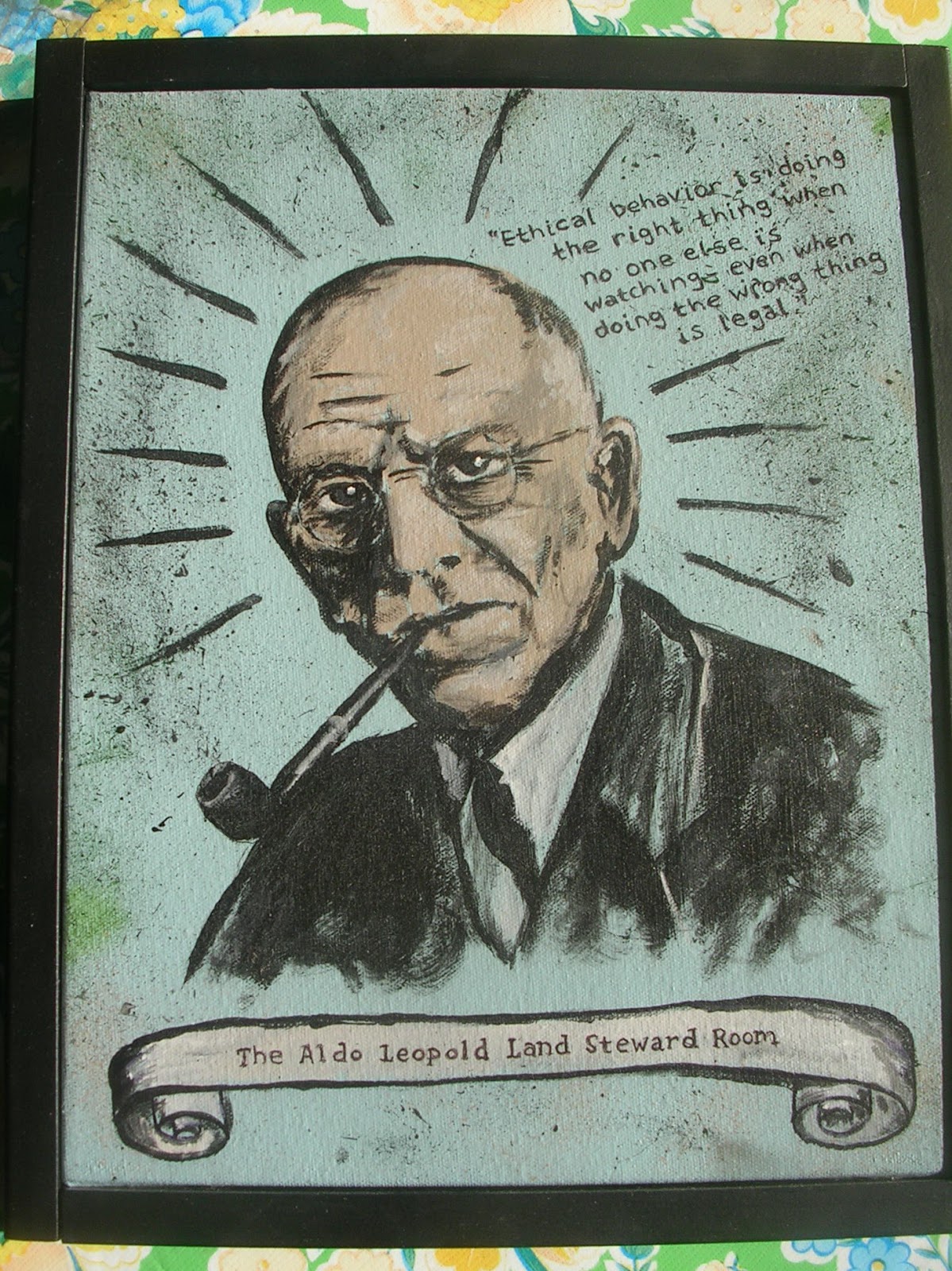
Guest-turned-friend Jim McGowin, bohemian poet and painter from St. Louis, created four incredible portraits of the environmentalists for whom the Mercantile's guest rooms are named. We're waiting until we reopen this coming spring to mount them on the doors of the rooms, but here is a sneak peek:

Rachel Carson by Jim McGowin  "If a child is to keep alive his sense of wonder…he needs the companionship of at least one adult who can share it, rediscovering with him the joy, excitement and mystery of the world we live in."


Wallace Stegner by Jim McGowin “Something will have gone out of us as a people if we let the remaining wilderness be destroyed... We need that wild country, even if we never do more than drive to its edge and look in.”
Aldo Leopold by Jim McGowin


David Brower by Jim McGowin

In keeping with a long-standing DR tradition of creating our own entertainment (since cities and "real" entertainment are so far away), our latest invention is the Artist in Residence Program here at the Milkweed Mercantile. Designed for visual artists, we are also open to hosting writers and poets. The basic idea is that we provide artists with a room in the Mercantile, a place to work, delicious food and the inspiration of 280 acres of Dancing Rabbit and its inhabitants. In return selected artists will create art, and spend at least eight hours sharing his/her artistic skills with members of the community by holding classes/seminars.  We hope to fill all five ten-day sessions with different artists. More info on the Milkweed Mercantile Artist in Residence Program can be found by clicking here. Please share this with your friends, neighbors, relatives, co-workers and anyone else who is an artist, knows artists, has seen artists, or has played an artist on TV...

Here's to a juicy, full, art-filled life!

Thanks for reading.

Love,
Alline


Thursday, September 13, 2012

I Am Intrepid, Invincible, and Kind of Stupid...

No personal photo in this post, and here's why:

I've always considered myself to be intrepid, invincible, brave and daring. But if I were to add another "i" in there, it would have to be for Idiot, because I'm also obviously not IMMUNE to poison ivy.

Last Monday, in preparation for Dancing Rabbit's Annual Open House we had our all-play Land Clean. Everyone in the community comes out and works to create a more beautiful place for our guests to explore and appreciate.

The Clean generally runs from 8-noon, and in the afternoon everyone goes home and works on his/her own warren. Kurt and I tackled a bunch of barrels that needed to be moved. Since they were sitting in a bed of poison ivy, which had wrapped itself around a fairly big wild grape vine that I'd like to encourage, I began work on it. I was absolutely convinced that I would not get a rash - I've been hiking through poison oak in California my entire life and have never had even a little spot of irritation. I had absolutely no idea just how insidious (so many good "i" words!) the oils in poison ivy are...

It all felt like a lark. Kurt kept warning me about the danger of poison ivy, I kept insisting that I was immune. Wearing a tank top, capris and leather gloves, with Felco pruners in hand, I chopped and pulled and stuffed three large black trash bags full before Kurt said "you are making me really nervous - please go take a shower!" So I did. Peeled off all of my clothes, jumped into the shower and began soaping myself up with hot water and lots of soap. Kurt ran to the house to do some quick internet research. A few minutes later the shower door flew open and Kurt yelled "STOP! DON'T USE SOAP!". Whoops. Too late. It seems that hot water and soap combine with the ushiol oil, making a solution that is easily spread everywhere. The hot water opens one's pores, and bingo presto you're covered with a rash that makes leprosy look Cinderella's .

But back to my drama. After scrubbing the oils deeply into my skin with hot soapy water and a washcloth, Kurt said what we needed  was rubbing alcohol, but he couldn't find any. Soaking wet and dripping in the shower, I gave him a couple of places to look but still he found nothing. Finally he gave up on the rubbing alcohol and came back with a bottle of gin. I couldn't help laughing out loud as I slathered myself with Gordon's Gin, imagining the distress the sight of all that gin running down the drain would cause drinkers everywhere...

Unfortunately, it didn't work very well. My arms, body, and ankles are covered with an ugly, bubbly, incredibly itchy rash. I take 20 minute showers in scalding hot water, which gives me relief for a couple of hours.There's Benedryl, and Tecnu, and, of course, whining. I'm also working on making the rash disappear with the power of thought. So far, well, there isn't much progress on that front. But I'll keep working on it.


Tuesday, August 14, 2012

In Praise of Beth Terry's book "Plastic Free"

 (not actually my house)
Those of you who know me even a smidge know that I really like am a bit obsessed with reading. Except for my husband and dogs, there are few things I adore more than cracking open a really good book, smelling that great book smell, and immersing myself in a new world (I have yet to join the e-book world). I read more fiction than non-fiction; my life is currently more intense than I’d like it to be, and so I often escape in the evenings by reading. I have little patience for poorly written or just plain stupid books – I’ve finally given myself permission to stop reading if I’m not totally enthralled by page 30 or so.  I find that when I read non-fiction I am even more demanding – not only do books have to be well-written but I really need them to
have content that feels valuable to me.


Which brings us to today’s post. Below is a review (actually, it’s a blatant love note and a rather impartial recommendation, but….) of Beth Terry’s Plastic Free: How I Kicked the Plastic Habit and How You Can, Too.


 The short version: Read it. It’s smart, concise, upbeat, engaging and filled with positive steps that anyone can take towards lessening the use of plastic. The book also explains why we need to care about plastic, and covers everything from recycling (where do things go when they go “away”?) to how to keep from feeling overwhelmed and discouraged. The main focus of this book is solutions rather than problems, and is a starting point for activism. A big thumbs-up!

The longer version:
I’ve lived at Dancing Rabbit Ecovillage for 13 years now and consider myself fairly savvy about environmental issues. While I don’t keep up on all the current controversies (such as which company we’ve been asked to boycott this week, etc.) I try to live the best I can. Our home and the building that houses our business, the Milkweed Mercantile, are made of local straw bales, reclaimed wood and other fairly low-impact materials. Both are powered by a wind turbine and solar panels. We are now connected to the grid, which eliminates the lead-acid batteries in which we used to store our power (we now use the national grid instead) and have a commitment to putting back twice as much power as we use. I don’t own a car but instead belong to a vehicle cooperative where I share two cars and a truck (let’s not forget about that tractor!) with 50 other people. I support local farmers and gardeners and dairies and try to eat as organically as possible. Our water is collected rainwater, our heat comes from locally harvested wood or scraps from a local pallet mill. And so on.

All of this pales in comparison to what Beth Terry is doing. As a fan of her blog (formerly Fake Plastic Fish, now MyPlasticFreeLife) I came to realize that while Beth and I have had similar experiences, we have taken two different paths. I am ashamed to say that my response was rather lacking in moral conviction, while she continues to walk her talk, every single day.

In 2008, while I was leading a Coast-to-Coast hike in northern England for the Sierra Club, we stopped at a small cove on the western coast. The beach was covered with plastic detritus – bottle caps of every color and size, syringes, plastic soda and milk bottles, and lots of odd pieces that were unidentifiable as anything except hunks of plastic. It was stunning in how utterly the trash covered the area. But what really depressed me was when our local friends told us that just three days before a group of folks had come down and picked up every bit of plastic and hauled dozens of bags away. With each incoming tide came a new delivery of plastic trash. Every. Single. Day.

After returning home, I read about the growing problem of what has been termed “marine litter,”  the Pacific Gyre Trash Island and the Algalita Marine Research Institute.

Before reading these articles I just thought the plastic mess was simply ugly. Now I realized that it was incredibly harmful to just about every living thing on the planet.

It gnawed at me, but I couldn’t really think of anything I could actually do – I don’t use plastic water bottles, I haul around my own grocery bags (according to the UN plastic bags and PET bottles re the most pervasive type of marine litter around the world, accounting for over 80 per cent of all rubbish collected in several of the regional seas assessed), and I don’t smoke (cigarette filters, tobacco packets and cigar tips make up 40 per cent of all marine litter in the Mediterranean).

Through those sites I found Chris Jordan’s photos of Laysan Albatross chicks on Midway Island. My reaction? Nausea. Repulsion. Deep sadness. However, I didn’t change much about my life, or talk about it much, or even consider what impact I might have if I put my mind to it. The issue felt way too big, way too global, way too much for me to make a difference.


This is the part I love. Beth became depressed, too. But she soon got over it, and moved on to mad. Here’s a snippet from the introduction to Plastic Free:


"In the summer of 2007, I was stuck at home for several weeks recuperating from an operation... I soon came to an article by journalist Susan Casey, entitled “Our Oceans are Turning Into Plastic . . . Are We?”—in, of all places, the online version of the magazine Men’s Health—and the shocking photo that would change everything.

The picture showed the decomposed carcass of a Laysan albatross, an ungainly looking sea bird that nests on Midway Island, which is halfway between California and Japan surrounded by thousands of miles of Pacific Ocean. The flesh of this particular bird—a chick!—had fallen away to reveal a rib cage filled with plastic bottle caps, disposable cigarette lighters, even a toothbrush—small pieces of plastic that had no business out there in the middle of nowhere. Pieces of plastic like those I myself used and tossed away every day.

Frozen in my desk chair, I stared at the awful image. For several seconds, I literally could not breathe.

And then, I forced myself to read the entire article. Tragically, this chick was not unique. Thousands of albatross mothers mistake tiny plastic pieces for food floating on the surface of the ocean. They swallow them up from the waters of the North Pacific Gyre, an area between the United States and Japan that is increasingly becoming known as the “Great Pacific Garbage Patch” because of all the plastic waste collecting there, and fly back to Midway to feed this “food” to their chicks. Except that plastic is not food. Huge numbers of baby albatrosses die of starvation each year, their bellies full of the dross of human civilization—the stuff that you and I throw away casually every day. And while the body of the bird will finally disintegrate and return to the earth, the plastic that killed it will linger on in the environment, never biodegrading, available once again to be eaten by future birds, so that the deadly cycle would continue. I sat and stared at the screen for half an hour, letting my heart break.

As I thought of how I used and tossed away pieces of plastic just like these every day, I felt as if, like Coleridge’s ancient mariner, I had helped kill this albatross.

I knew my life had to change. And that, like the mariner, I had to tell people about the albatross.
The day I saw that photo, I committed to looking at my own plastic consumption and plastic waste and figuring out what changes I could make. 

By day, I continued my accounting job. But nights and weekends were consumed by plastic! In the years since my plastic awakening, I’ve gone from personally generating almost four pounds of plastic waste per month to a little over two pounds per year (the average American generates between 88 and 120 pounds per year, and that's only what they throw away at home!), and I am continuing the downward trend. 

No one’s perfect, least of all me. This journey is ongoing. … I’m in it for the long haul. And I still experience some of the frustrations and challenges I did back in 2007. I didn’t write this book to tell anyone what to do, but as an invitation to join me in this journey of personal and ecological discovery.”

That’s just the introduction. The book feels like a rip-roaring adventure that the reader can actually participate in. There is so much to learn, and absolutely NO preaching.  I find myself feeling better, more empowered, and considering the idea that maybe, just maybe, I can make a dent in what is happening in the world.

Thanks Beth, for reminding me about the power of one!

Love,
Alline

PS Chris Jordan and his team are making a film about the albatross chicks and Midway Island. 
PPS Join me on Goodreads to share book recommendations and opinions!

PPPS A couple of things I learned from Beth’s book:
  1. I still love Tom’s of Maine Toothpaste (even though it’s now owned by Colgate-Palmolive) but find the new plastic tubes offensive. The solution? Send them back to the company. The Milkweed Mercantile is now a Tom’s tube recycling center for Dancing Rabbit Ecovillage.
  2. There is a website called Tapitwater.comhttp://www.tapitwater.com/?cel=1 where you can find businesses that will let you fill your reuseable water bottles with tap water. Check it out!
  3. A free downloadable Reader's Guide for Plastic Free is available by clicking here.


For more widgets please visit www.yourminis.com